Understand
Know what is changing—and what it means for your organisation.
 SafetyOfAIStart a conversation ↗
Organisational preparedness for the age of AI
AI capability is accelerating.Organisational preparedness isn’t.
Understand where you stand. See what requires attention. Move forward with confidence.
One journey. Three essential capabilities.
Every organisation must understand what is changing, prepare its people and decisions, and build the resilience to thrive.
Know what is changing—and what it means for your organisation.
Know where you stand and what requires attention.
Progress with the capability and confidence to adapt.
One integrated capability
Uncertainty becomes understanding. Understanding becomes clarity. Clarity becomes controlled progress.
Research creates understanding.HDRS™ creates clarity.BOSS™ creates execution.
See what is changing, why it matters and where organisational pressure is emerging.
Explore the evidence ↗02 · CLARITYTurn organisational evidence into clarity about preparedness, resilience and priorities.
Understand preparedness ↗03 · EXECUTIONTurn clarity into governed action, accountable progress and continuous improvement.
In development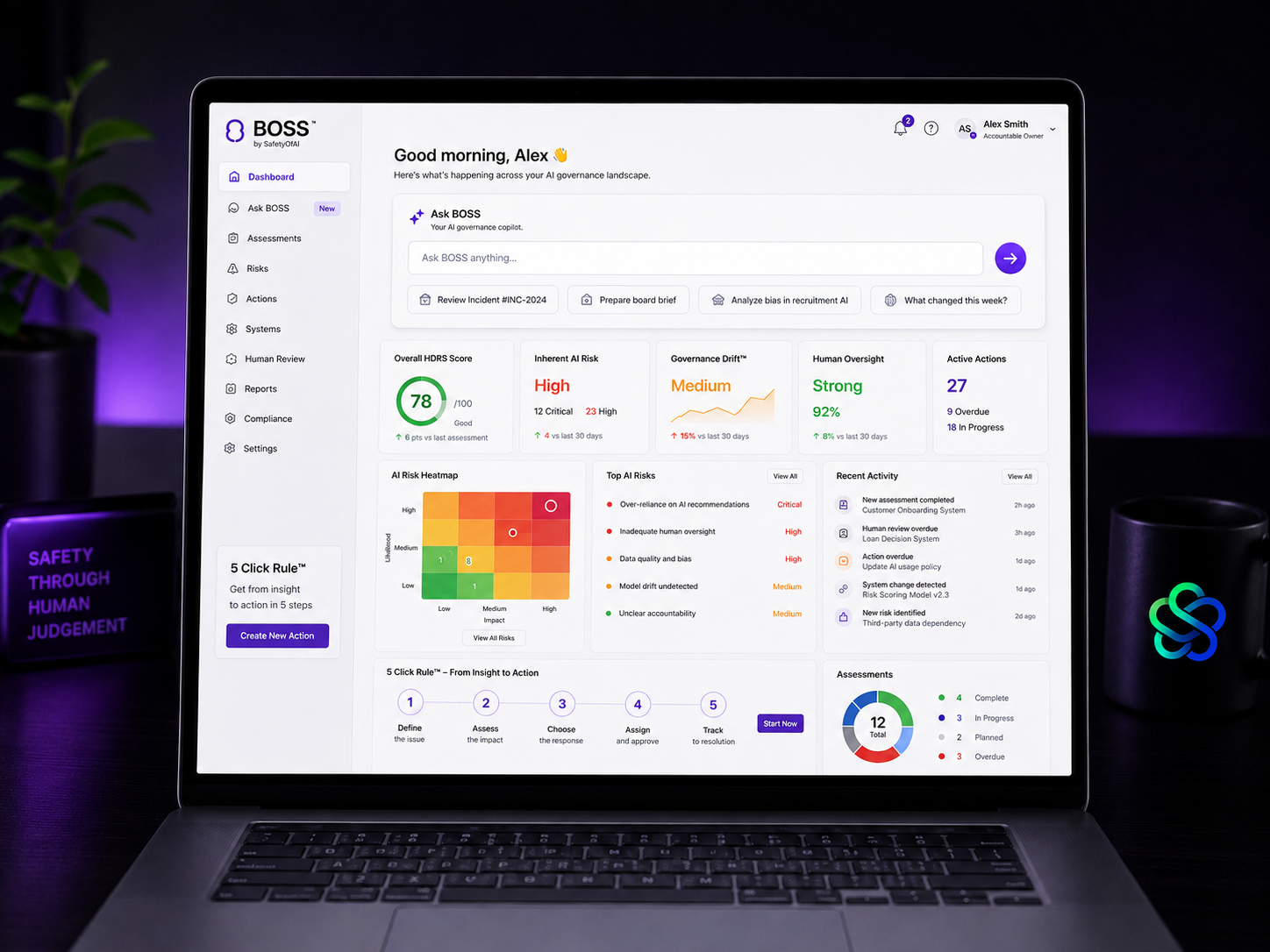
The preparedness gap
AI adoption can move faster than accountability, judgement and organisational capability. That gap becomes risk.
Acceleration without preparedness is not progress. It is exposure.Understand your organisation’s preparedness ↗
Our mission
SafetyOfAI exists to ensure that as AI capability grows, human judgement, accountability and opportunity grow with it.
The long-term direction
Today, we help organisations prepare. Over time, that work will contribute to the infrastructure people, businesses and society need to thrive alongside increasingly capable AI.
Explore the long-term vision ↗Why SafetyOfAI
We believe organisations should understand what is changing before deciding what to do.
Technology should improve leadership, accountability and organisational capability—not replace them.
Our work is designed to help organisations adapt continuously as AI becomes increasingly capable over the coming years.
The organisations that thrive in the age of AI will not simply adopt it.They will prepare for it.
The question that matters
If the answer is unclear, that is the place to begin.
Start a conversation ↗Confidential. Founder-led. No obligation.